Background
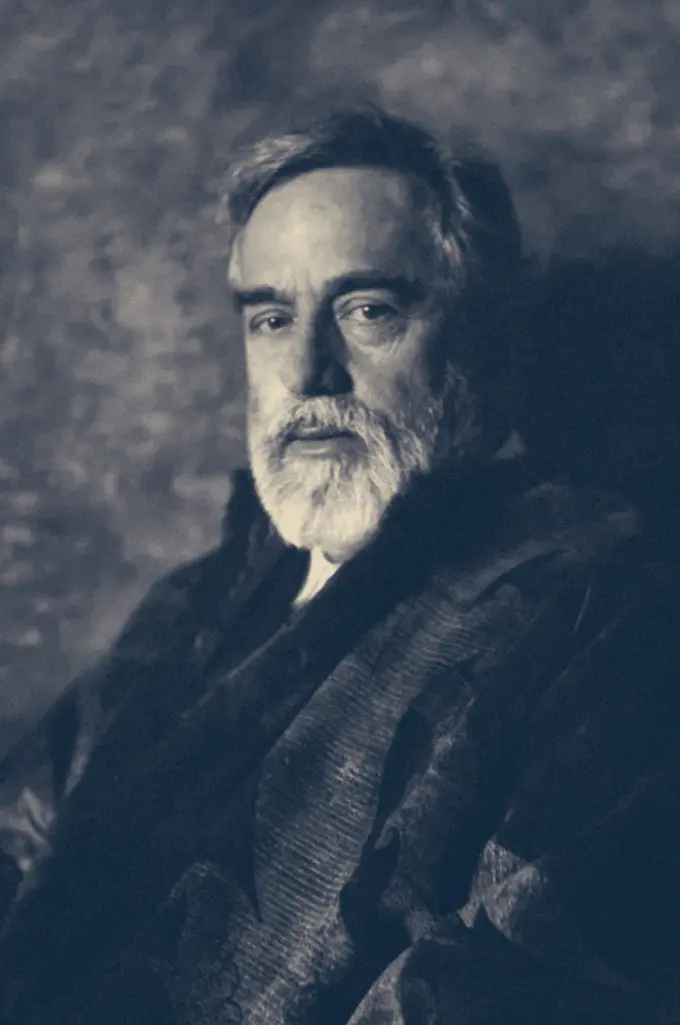
Born in Granada in 1871, Mariano Fortuny y Madrazo grew up in a highly cultivated artistic environment shaped by his father, the celebrated painter Mariano Fortuny y Marsal. After his father’s early death, the family settled in Paris before moving to Venice in 1889, where Fortuny developed a lifelong fascination with the art, craftsmanship, and theatricality of the past. Influenced by the intellectual and artistic circles surrounding his mother, as well as by the discovery of Wagner’s universe in Bayreuth, he embraced the ideal of the Gesamtkunstwerk — the total work of art — uniting multiple disciplines within a single creative vision.
Signature Style
A true polymath, Fortuny combined the sensibilities of artist, inventor, craftsman, and technician. His work is defined by a refined mastery of color, light, texture, and transparency, visible across painting, printmaking, photography, textile design, fashion, lighting, and stagecraft. Working from his Venetian studio in the Palazzo Pesaro-Orfei, he developed an unmistakable aesthetic rooted in historical inspiration yet remarkably modern in execution. His fabrics and garments, especially his pleated silk creations, reveal a constant dialogue between technical experimentation and timeless elegance.
Showstoppers
A prolific inventor and designer, Fortuny patented innovative systems for indirect stage lighting and theatrical domes, installed in major European theaters from the early 1900s onward. In 1907, he launched his textile printing workshops, later establishing a factory on the Giudecca and opening a Paris boutique on Boulevard Haussmann in 1919. His celebrated fabrics, lamps, furniture, and fashion designs became synonymous with refined luxury. After World War I, he emerged as one of the most sought-after decorators of elite interiors, designing spaces for figures such as Consuelo Vanderbilt and Marie-Laure de Noailles, while continuing to create scenographies and theatrical installations into the 1930s.