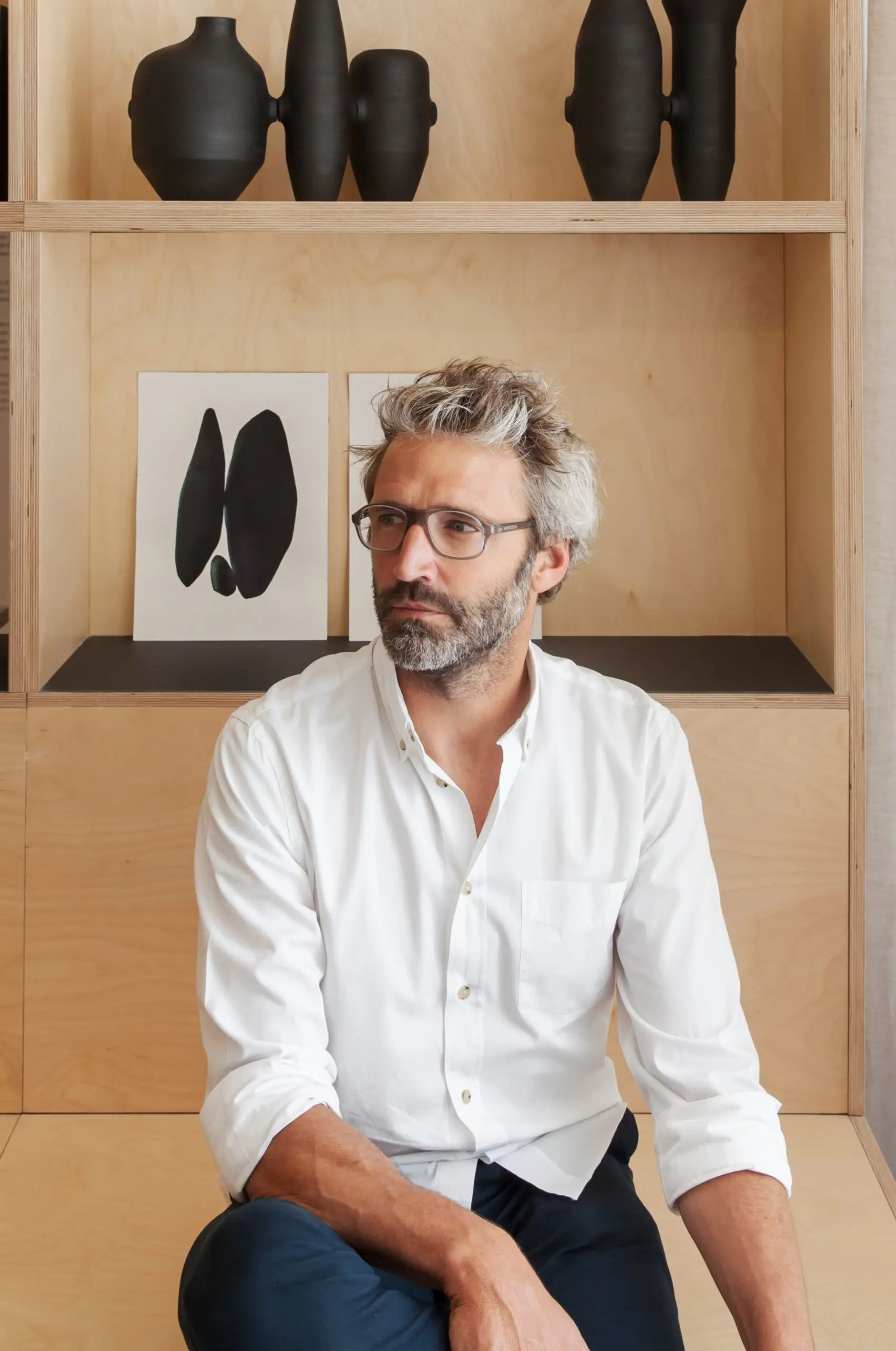
There is a sense of contemplative communion when entering Made in Situ, as though the universe were reconnecting through its elements. Fire, earth and water shaped into timeless vessels. Then the materials take over: cork, wood, metal and stone appear in man-made forms, shaped by gestures as old as humanity. And suddenly the visitor understands — or rather, intuitively feels — what Noé Duchaufour-Lawrance must have felt when imagining, drawing and creating the designs on view. The works on display are not just objects and pieces of furniture. They reveal a deeply personal vision of design, one shaped as much by human encounters and ancestral knowledge as by the materials themselves. Duchaufour-Lawrance is saying that design can start with a landscape, a chance encounter or the quiet observation of an artisan at work. And this, in turn, becomes the foundation of an extraordinary creative journey.


Presented at the Galerie des Gobelins in Paris from 9 October to 29 November 2026, Made in Situ brings together, for the first time, the seven collections born from the designer’s ongoing exploration of the relationship between people, materials and places. Organised in partnership with the Mobilier National, the exhibition unfolds as a meditation on the meaning of creation itself, proposing a vision of design rooted in patience, collaboration and an intimate understanding of the territories from which it emerges. Known for his fluid, sculptural vocabulary and elegant organic forms, Duchaufour-Lawrance has developed a distinctive practice that moves effortlessly between furniture, interiors and collectible design. Trained in sculpture, he has collaborated with prestigious maisons including Hermès and Dior, while conceiving interiors such as London’s celebrated Sketch restaurant. Yet Made in Situ represents a significant departure from conventional design commissions, allowing him to pursue a more instinctive and exploratory path.
“Made in Situ is undoubtedly the freest project I have undertaken. It was born without a brief or a set of specifications, driven solely by the desire to meet people, understand them, explore territories and work with those who shape them. It is a project made up of happy coincidences, curiosity, listening and time shared. It is a turning point in my work,” Says Duchaufour-Lawrance. “While Made in Situ speaks of my journey, my origins and my convictions, it also recounts a unique adventure for a designer: a collective endeavour that has spanned the long term. It demonstrates what design can produce when it listens to a territory, when it slows down, looks and learns. I am deeply joyful today to present the full scope of this work for the first time. This exhibition reveals Made in Situ in all its glory, as an artistic and human project, where design becomes a relational tool as well as a creative exercise”

The story began in 2017, when Duchaufour-Lawrance relocated to Lisbon, seeking distance from the rhythms and expectations of his established career. What followed was not a predetermined collection, but a series of encounters with Portuguese landscapes, artisans and traditions. Gradually, these discoveries evolved into a creative philosophy in which the designer assumes the role of observer, collaborator and interpreter rather than sole author. Each collection begins with a territory and its particular resources. Its geography, history and cultural practices inform the creative process, while local craftspeople contribute techniques and knowledge refined over generations. The resulting objects possess a contemporary sensibility without severing their connection to the past.


This dialogue between tradition and innovation becomes particularly compelling in Barro Negro, inspired by the ancient black pottery of Molelos in northern Portugal. Working with ceramicists Xana Monteiro and Carlos Lima, Duchaufour-Lawrance developed sculptural vessels whose interconnecting forms evoke the granite formations of the Serra do Caramulo. Arranged in a circle, the twelve vases suggest community, continuity and the enduring rituals of collective craftsmanship. Elsewhere, Burnt Cork transforms a material associated with ecological devastation into an unexpected expression of beauty. Inspired by the forest fires that marked the designer’s arrival in Portugal, the collection incorporates both healthy and fire-damaged cork into furniture of striking architectural simplicity. Beyond its formal refinement, the project questions conventional distinctions between valuable materials and discarded resources, offering a thoughtful response to environmental fragility.
Nature’s cycles and transformations also inform Bronze & Beeswax, a collection of candlesticks developed through encounters with foundry workers, beekeepers and wax artisans. Here, polished bronze meets the delicate architecture of honeycomb, while melting wax gradually alters the composition of the objects. The tension between permanence and impermanence becomes an essential part of their beauty.

In Azulejos, Duchaufour-Lawrance turns to Portugal’s celebrated ceramic tradition. Created in collaboration with the historic Viúva Lamego workshop in Lisbon, the collection explores the unpredictable qualities of enamel and firing. An expansive ceramic triptych traces the Atlantic coastline between Brittany, where the designer grew up, and Lisbon, where he now lives, transforming geography into an intimate cartography of memory.
Two collections presented in France for the first time further illuminate the project’s evolving character. Xisto draws inspiration from the schist landscapes of the Côa Valley, where prehistoric engravings, terraced vineyards and contemporary quarrying coexist. Stone becomes a repository of geological and human time, translated into furniture and lighting with restrained monumentality.
Caretos, meanwhile, offers perhaps the clearest expression of the designer’s collaborative philosophy. Inspired by the traditional winter festivities of Lazarim, whose elaborate carved masks are central to local celebrations, the project invited artisans to translate their skills into a series of wooden stools. Duchaufour-Lawrance deliberately stepped away from directing the creative outcome, allowing their individual imaginations to take precedence.
The final collection, Chêne & Liège, returns the narrative to France, specifically the Massif des Maures in Provence. Using timber from cork oaks destroyed by wildfires, the designer worked with local craftspeople to create furniture that preserves the material’s raw character. The collection becomes both a tribute to a wounded landscape and an affirmation of the possibilities of regeneration.


At the Galerie des Gobelins, these seven chapters are brought to life through an immersive scenography conceived by Duchaufour-Lawrance and Clémence Farrell. Rather than relying on technological spectacle, the exhibition privileges material presence and sensory experience. Light, sound, film and scent accompany visitors through successive environments, while drawings, portraits and documentary material reveal the encounters and processes behind each creation.
A particularly meaningful dimension of the exhibition lies in its dialogue with historical works from the Mobilier National‘s collections. Selected by scientific curator Hugues Jacquet, tapestries, decorative objects and historic furnishings appear alongside Duchaufour-Lawrance‘s contemporary pieces, revealing contrasting interpretations of nature across centuries. Where earlier decorative traditions frequently sought to represent or idealise the natural world, Made in Situ approaches it as an active participant in the creative process.
Ultimately, the exhibition reveals a designer increasingly concerned not simply with what objects look like, but with what they carry: the memory of a landscape, the intelligence of a hand, the trace of a human relationship. In an era defined by accelerating production and consumption, Duchaufour-Lawrance proposes a quieter, more attentive alternative.
Made in Situ by Noé Duchaufour-Lawrance, 9 October–29 November 2026, Galerie des Gobelins, Mobilier National