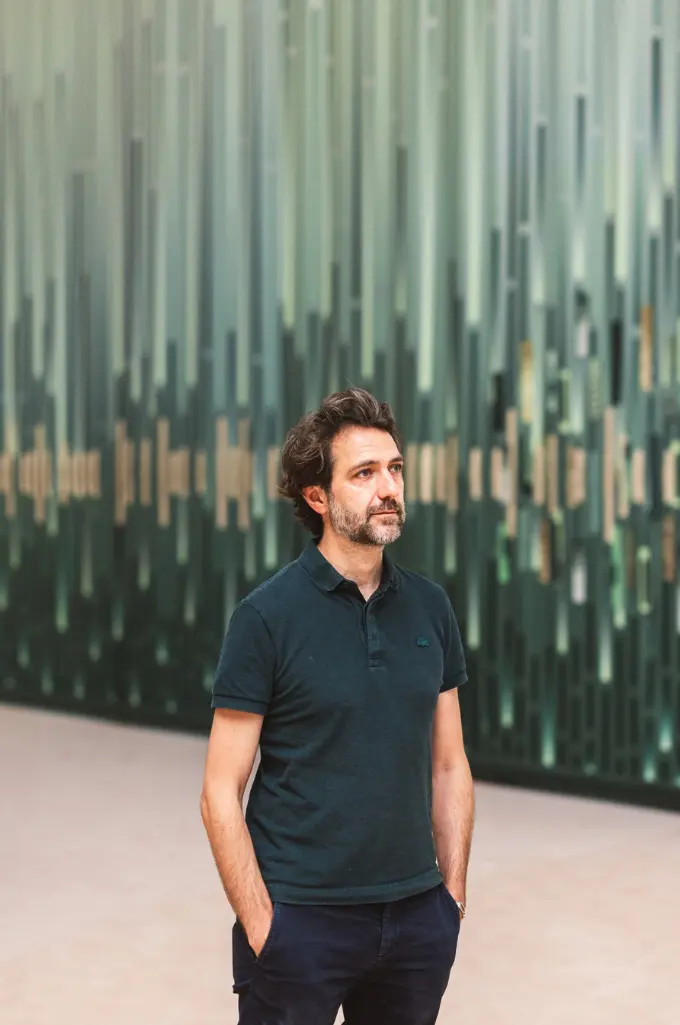
After years wrapped in scaffolding and silence, the Grand Palais reopens its doors on June 20, 2025, revealing not only its restored grandeur but also a breathtaking new gesture of contemporary craftsmanship. In a striking fusion of heritage and innovation, the historic monument unveils a monumental curtain—a sculptural installation measuring eight meters high and fifteen meters wide—that symbolically bridges the nave with the central plaza of the building. This awe-inspiring piece is the result of an extraordinary collaboration between the Grand Palais and le19M, the Parisian hub dedicated to preserving and celebrating the artistic crafts of fashion and decoration. Supported by CHANEL, the Grand Palais’ exclusive and long-standing patron, the curtain is more than a decorative element—it is a profound expression of cultural continuity, craftsmanship, and contemporary creation. The work was conceived and orchestrated by Studio MTX, the creative atelier of Atelier Montex, known for its mastery in architectural embroidery. Their vision was to create a piece that resonates with the monumental history of the Grand Palais while asserting a contemporary visual language. The result is an elegant interplay of materials, textures, and forms that feels simultaneously timeless and current.

Its color palette draws directly from the architectural vocabulary of the building. Centered around reseda green—the emblematic shade of the palace’s iconic ironwork—the curtain extends into subtle gradients of white and deep blue, evoking a shifting sky, a horizon in motion. Suspended delicately from the beams of the Grand Palais, the curtain consists of nine mobile panels. Its manually operated opening system pays homage to the traditions of theatrical stagecraft, a simple and respectful gesture that enhances rather than distracts from its presence. Even when open, the curtain retains side panels that echo the handwork of the artisans, allowing its sculptural quality to remain ever visible.Verticality is at the heart of this monumental piece. It ascends through the space like a suspended rain of light, composed of thousands of four-centimeter-wide vertical strips. The effect is an architectural mise en abyme—mirroring the cathedral-like height of the nave and drawing the eye naturally toward the luminous canopy of glass and steel above.

At eye level, where the viewer might pause and linger, the curtain reveals a more intimate narrative. Seventy distinct ornamental bands, each created by one of the twelve Maisons of le19M, interpret the central motif—a vertical rainfall of light—through their own craft and sensibility. Each Maison brought a unique variation to the whole: Atelier Montex embroidered delicate geometric constellations from glass tubes and beads. Goossens, the historic goldsmith and parurier, shaped ephemeral golden brass flowers that seem to shimmer like petals caught in a downpour. Maison Lesage, the legendary embroidery house, layered beaded and sequined motifs over cotton tweed, enhanced by shimmering crystal droplets. Lemarié, guardian of the feather arts since the 19th century, composed a constellation of feathers using intricate marquetry. Atelier Lognon, with its mastery of pleating, contributed an accordion-folded textile crafted through centuries-old hand techniques. Maison Michel, the iconic milliner, assembled felt, grosgrain, and raffia into overlapping bands that reflect their expertise in hat-making, trimming, and straw work. Massaro, the historic shoemaker, took inspiration from English brogues, creating hand-punched and wax-stitched leather strips with delicately tinted edges. Paloma, known for its work in fluid, soft couture, offered two smocked motifs: one in crepe de Chine, defined by precise, regular pleats, and another in silk organza, gathered through delicate embroidery stitches.

Together, these contributions form a layered, polyphonic dialogue between métiers d’art and monumental space. Over 900 hours of design and 720 hours of meticulous craftsmanship were invested in bringing this curtain to life—an extraordinary commitment to excellence that underscores the mission of le19M.
Since its inauguration in 2021, le19M has become a unique haven for artisanal creation and close collaborator of Invisible Collection, sharing the same passion for unique savoir-faire. It is the culmination of a policy launched by CHANEL in the 1980s to support the preservation of savoir-faire. Since 2021, le19M has brought together 12 Maisons, as well as an embroidery school, forming a unique community of 700 artisans and experts across 29 Métiers d’art recognised by the Institut pour les Savoir-Faire Français.