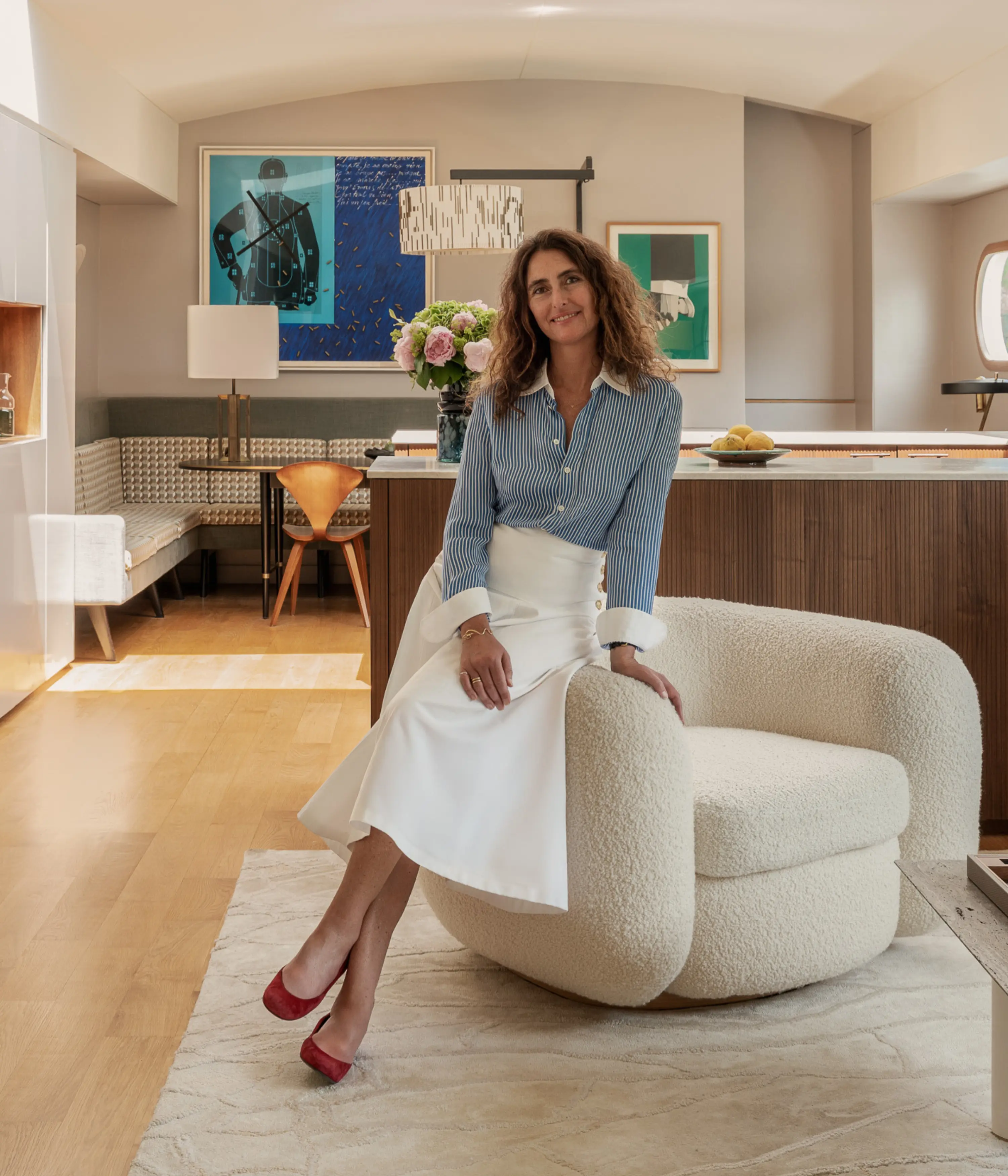
Before Charlotte Biltgen sets sail for New York and the U.S. debut of her furniture collection at Invisible Collection’s Upper East Side gallery, the French designer invited us aboard Txakoli, her astonishingly refined, floating family home on the Seine. In an exclusive video, Biltgen invites below deck, where steel and stillness meet soft tactility, in a space that is both a sanctuary and a working atelier. “I use the boat as a kind of laboratory,” she confesses in the video, “It’s where I can test out new designs.” Biltgen’s voyage began in 2005, when she and her husband Cédric stumbled upon the bare-bones barge in a Burgundy boatyard — little more than a hull and a few quarters. “It was very rudimentary… but I was immediately seduced,” she recalled in Architectural Digest, “I love unusual projects.” From that moment, Txakoli became a deeply personal undertaking. It took navigating half the rivers of France, and years of structural transformation — replacing plastic skylights with glass, raising ceilings over nine feet, integrating a Seine-water filtration system — before the 2,000-square-foot vessel could fully reflect Biltgen’s singular design sensibility. “Living on a boat is like living in a normal apartment—she says nonchalantly—except of course for the oblong windows and the constant view of the moving water all around.”


Crucially, she avoids the obvious: no tired nautical themes in her home. There’s no blue-and-white palette, no rope-wrapped banisters or token seashells. Instead, every area offers a neutral base, punctuated by subtle strokes of color and a harmonious mix of the unexpected. Take the bedroom: the ever-changing reflections of the water dance across the ceiling, playing with the graphic motifs of a headboard dressed in African fabric. All around, artworks and objects from past travels, and a flash of yellow: “The Klay armchair in yellow velvet plays very well here.” This is a house that glows gently, rather than shouting for attention. Among her own pieces, there are also carefully chosen companions: a Starck chair salvaged from Café Costes, a Louis Kalff lamp, curated art. In the kitchen, a brass-and-wood table from the 1960s, unearthed at a flea market in Brussels, sits beneath an original ceiling fixture designed in collaboration with Studio MTX, its lampshade composed of brass beads mounted on metal mesh.